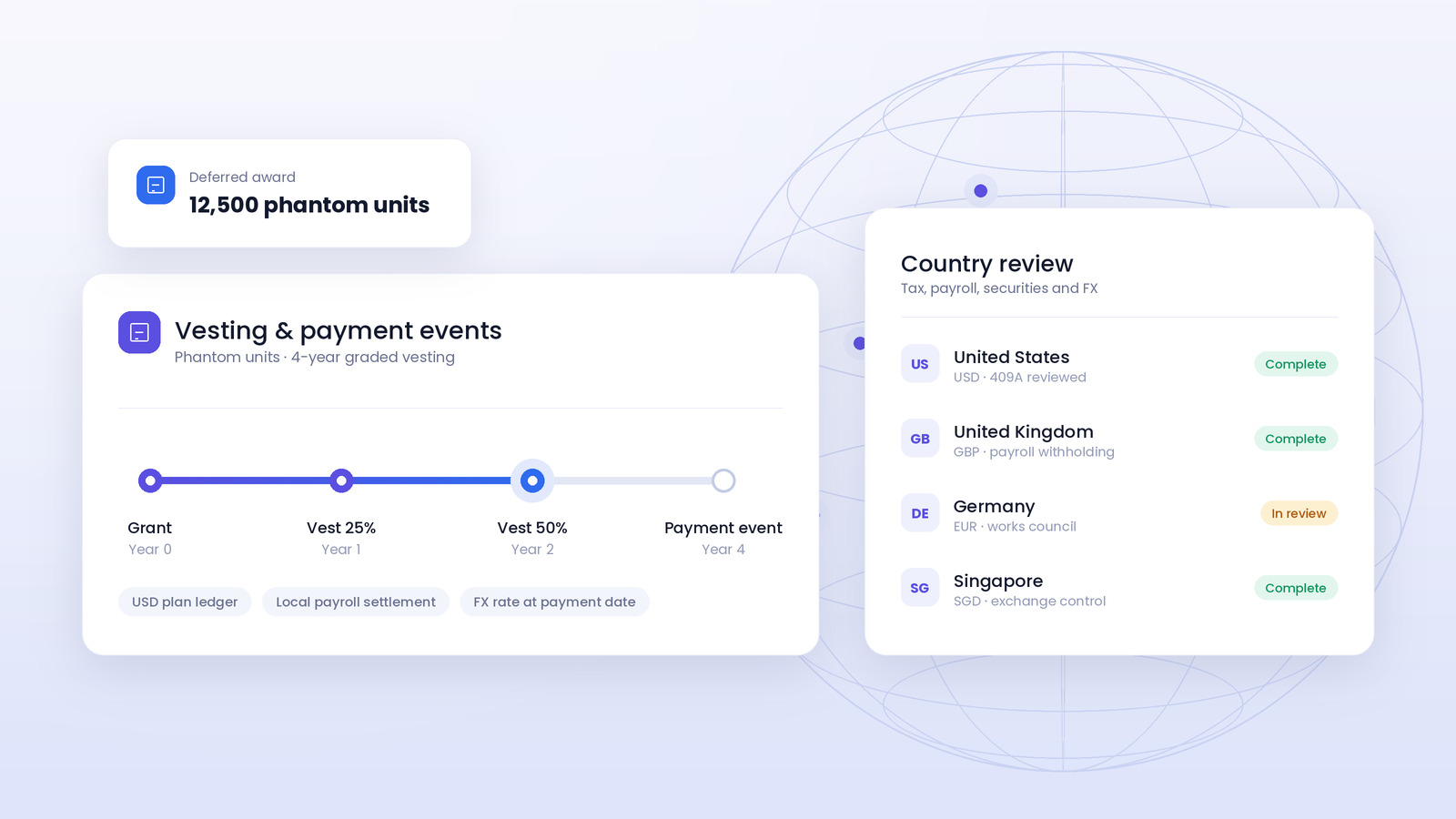


A phantom equity plan is not complete when the employer decides how many units to grant or how they vest. The harder design question is when those units actually turn into money. Exit events, terminations, retirement, death, disability, and scheduled payment dates can produce very different outcomes for employees and very different cash obligations for the company.
Employers should define payout events before grants are issued, because the payment trigger affects valuation, forfeiture, payroll, liquidity, employee expectations, and—depending on the jurisdiction—tax and deferred-compensation compliance. In the United States, Section 409A can restrict when nonqualified deferred compensation may be paid and how payment timing may be changed. International participants can face separate local rules.
This article is a plan-design framework, not legal, tax, accounting, securities, or investment advice. Employers should have counsel and tax advisers review the final plan terms for every relevant jurisdiction.
Separate Vesting From Payment
Vesting answers whether an employee has earned a contractual right under the plan. Payment answers when that right is settled. Those dates do not need to be the same.
An employee might become fully vested after four years but receive no cash until a company sale. Another plan might pay vested units annually on a fixed schedule. A third might pay at retirement or termination. Treating vesting and payment as separate design decisions gives employers more control and makes the employee experience easier to explain.
Exit or Change-in-Control Payouts
A company sale is one of the most common phantom equity payout events because the transaction creates a natural valuation point and often provides liquidity. The plan should define exactly what qualifies as an exit or change in control rather than relying on informal language such as “when the company is sold.”
Questions include whether an asset sale counts, whether a majority-equity sale is sufficient, whether an IPO is a payment event, whether partial secondary transactions qualify, and how earnouts or contingent consideration are handled.
The plan should also state whether unvested awards accelerate, remain subject to vesting, or are forfeited at the transaction. If payments depend on proceeds actually received by shareholders, the documents should explain how escrow, holdbacks, earnouts, and post-closing adjustments affect participant payments.
Termination of Employment
Termination is often the most complicated payout event because the employer must distinguish the reason for departure, the participant’s vested status, and the intended retention purpose of the award.
A common approach is to forfeit unvested units and preserve vested units, but plans vary widely. Some cash out vested units after termination. Others keep vested units outstanding until the original exit or scheduled payment date. Some provide different treatment for voluntary resignation, termination without cause, termination for cause, redundancy, death, or disability.
Define these categories precisely. A vague “good leaver/bad leaver” concept can create disputes if the underlying documents do not specify which events fall into each category.
Retirement
Retirement can be treated as a favorable leaver event, but the employer should decide whether retirement causes immediate payment, continued participation until a later payment date, or accelerated vesting.
If the plan includes a retirement definition, consider age, service, board approval, notice requirements, and whether the participant can immediately join a competitor. Employers should also determine whether retirement treatment differs across countries where statutory retirement concepts vary.
Death and Disability
Death and disability provisions should be operationally clear. The plan should identify whether awards accelerate, who receives payment after death, how beneficiaries are designated, what evidence is required, and when valuation occurs.
For disability, the plan should use a defined standard rather than relying on a manager’s judgment. The definition may need to coordinate with employment law, insurance plans, and tax rules.
Scheduled Payment Dates
Some employers choose fixed or formula-based payment dates rather than waiting for a corporate transaction. Examples include a payment five years after grant, annual settlement after vesting, or payment on a specified calendar date.
Scheduled payments create more certainty for employees, but they also create a predictable corporate cash requirement even if the company has not had a liquidity event. Finance should model that obligation before grants are made.
The employer should also define what happens if the participant terminates before the scheduled date, whether payment can be made in installments, and whether the valuation is measured at vesting, at the payment date, or at another specified point.
Installments Versus Lump-Sum Payments
A lump sum is easy to understand but can create a large single-period cash obligation. Installments can smooth cash flow and may support retention, but they add administration and can introduce additional tax and deferred-compensation issues.
If installments are used, specify the number of installments, payment frequency, interest or notional growth between payments, treatment after death, and whether unpaid installments accelerate following a later event. The plan should not leave these details to discretionary decisions after an award becomes payable.
Choose the Valuation Date Carefully
The payout event and valuation date should work together. In a sale, transaction value may provide a clear reference. For scheduled or termination payments in a private company, the employer needs an approved valuation methodology.
Define whether the plan uses enterprise value, equity value, a board-approved fair market value, an independent appraisal, a financing-round value, or another formula. If the award is appreciation-only, the calculation must also compare the final value with the grant-date base value.
State who has authority to determine value, how frequently valuations occur, and whether the determination is final except for manifest error. Consistency matters as much as the formula itself.
Define Forfeiture Before a Leaver Event Happens
Forfeiture rules should be visible in the plan and award agreement from the beginning. Unvested units are often forfeited at termination, but vested units may remain outstanding, be paid, or be forfeited in limited circumstances such as fraud, misconduct, or breach of restrictive covenants where legally enforceable.
Clawback and malus provisions should be drafted carefully and reviewed locally. A rule that is enforceable in one country may not work the same way elsewhere.
Map Every Event to an Administrative Workflow
A payout rule is only useful if HR, finance, payroll, and the plan administrator can execute it. For every event, define who reports it, which date controls, who confirms vesting, who approves valuation, which entity pays, what currency is used, and how withholding is communicated.
Termination workflows are especially important for international employees because employment end dates, payroll cutoffs, tax residency, employing entity, and payment currency may all change at once.
A Practical Payout Event Matrix
- Change in control: define qualifying transactions, acceleration, valuation, and treatment of contingent proceeds.
- Voluntary resignation: define unvested forfeiture and treatment of vested units.
- Termination without cause: decide whether treatment differs from resignation.
- Termination for cause: define cause precisely and any vested-unit consequences.
- Retirement: define eligibility, vesting treatment, and payment timing.
- Death or disability: define acceleration, beneficiaries, evidence, and payment process.
- Scheduled date: define exact timing, valuation, and installment rules.
Do Not Create Post-Grant Discretion Over Payment Timing
Employers sometimes want the board to decide later when cash is available. That flexibility can conflict with deferred-compensation rules and can create employee-relations problems. Payment timing should generally be determined under the approved plan terms rather than renegotiated award by award when a payment becomes economically inconvenient.
For U.S. taxpayers or plans with U.S. connections, employers should specifically review Section 409A before changing payment timing or allowing participants to elect among payment dates.
How Redii Supports Phantom Equity Administration
Redii’s Deferred Compensation and Phantom Equity capabilities help employers operationalize approved plan rules across employee populations. The platform can maintain awards, vesting, payout timing, participant records, and reporting so payout events are administered consistently rather than reconstructed from spreadsheets when someone leaves or a transaction occurs.
Redii does not determine the legal or tax treatment of an award. Its role is to turn the employer’s approved plan design into a repeatable administrative process.
Design the Payment Event Before Granting the Award
Phantom equity works best when employees can answer three questions: when do I earn it, what determines its value, and when do I get paid? If the third answer is unclear, the plan is incomplete.
Define each payout event, its valuation date, leaver treatment, installment mechanics, and operational owner before grants are issued. That gives employees a clearer incentive and gives finance a liability it can actually model.
Employer Decision Framework
Treat vesting and payment as separate design decisions.
The useful next step is to convert the article's concepts into a documented employer decision, with clear owners, evidence and review dates.
- Map every leaver and corporate event to a written payment outcome.
- Fix the valuation date and calculation method before grants are made.
- Coordinate payroll, withholding and cash-flow responsibilities by country.
For implementation, see Redii Deferred Compensation. Redii can help administer the approved design, but employers should obtain legal, tax, investment and insurance advice for the countries and employee populations involved.
Authoritative References
Frequently Asked Questions
Does vested phantom equity have to be paid when an employee leaves?
No universal rule applies. The plan documents may require immediate payment, continued participation until a later event, installments, or other treatment, subject to applicable law and tax rules.
Can phantom equity be paid only when the company is sold?
Yes, a plan can be designed around a qualifying exit event, but the definition of that event, treatment of unvested awards, valuation, and deferred-compensation rules should be addressed expressly.
Can phantom equity payouts be made in installments?
They can be if the plan is designed that way and applicable law permits it. The number, frequency, valuation mechanics, and treatment of unpaid installments should be defined in advance.
What happens to phantom equity at retirement?
That depends on the plan. Retirement may trigger payment, continued vesting, accelerated vesting, or continued participation until another payment event. The retirement definition and outcome should be explicit.