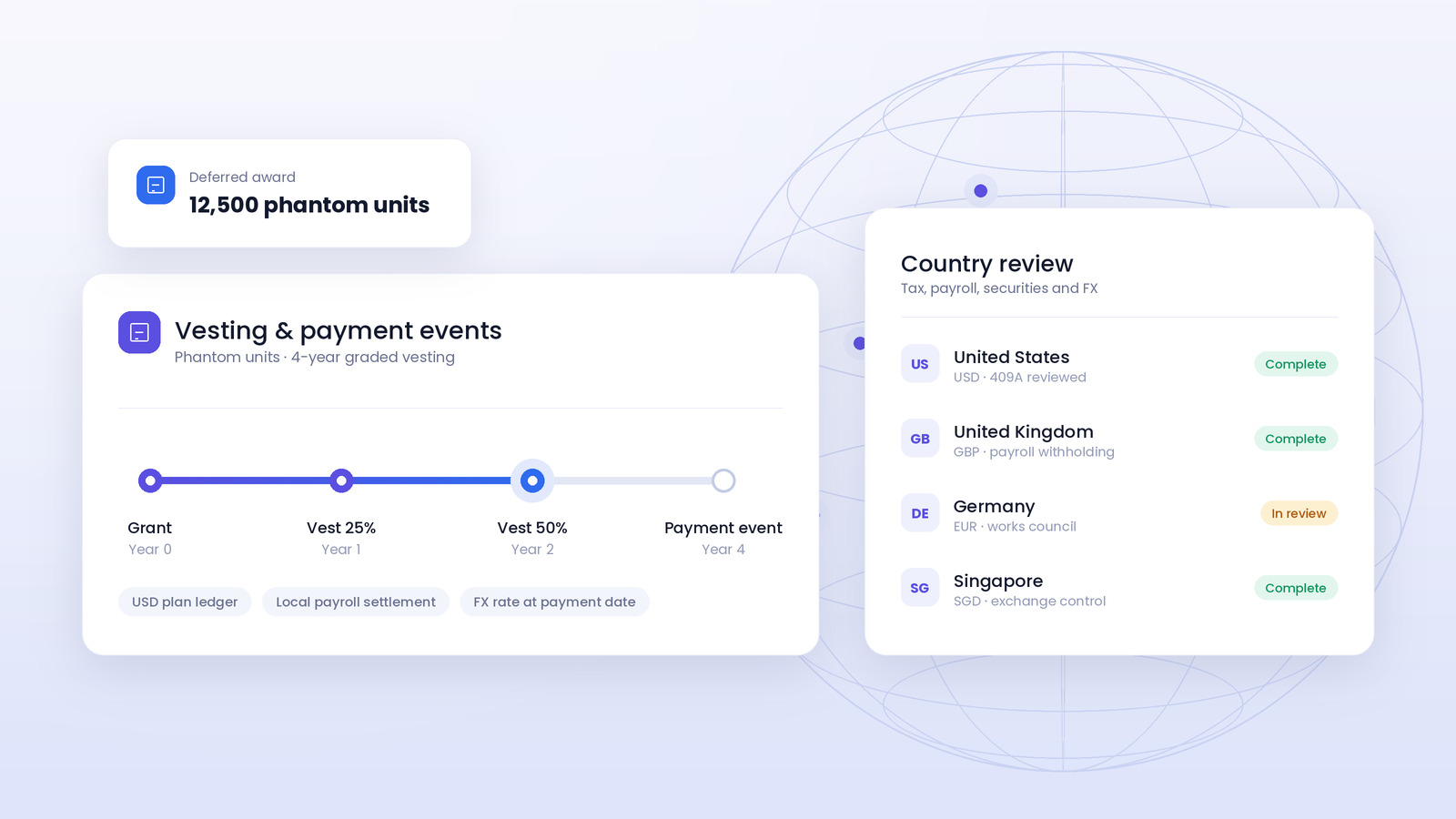



For international employees, the choice between phantom equity and stock options is less about which award sounds more attractive and more about which obligations the company is prepared to manage. Stock options can create real ownership economics and potential shareholder participation. Phantom equity can mirror company value without issuing shares, but it creates a contractual payment obligation that must be administered and funded.
The tax and legal treatment can vary significantly by country and participant. In the United States, the IRS’s current Stock Options guidance distinguishes statutory from nonstatutory options, while Publication 15-A describes Section 409A requirements for nonqualified deferred compensation. International employers should therefore treat the structure decision as a cross-functional compensation project, not simply an equity-platform configuration.
This comparison is a decision framework for HR, finance, legal, tax, and global mobility teams. It is not legal, tax, securities, accounting, or investment advice.
The Core Difference: Ownership Versus a Contractual Value Right
A stock option gives the participant a right to purchase actual company shares at a defined exercise price, subject to the plan terms. If exercised, the employee becomes a shareholder to the extent of the acquired shares and receives whatever rights attach to that class of stock.
Phantom equity generally does not issue shares. Instead, the company grants hypothetical units or a contractual benefit tied to the value or appreciation of the business. At a defined payment event, the company typically settles the award in cash or another permitted form under the plan.
This distinction drives most downstream differences: dilution, governance, tax timing, payroll, securities treatment, liquidity, accounting, and employee expectations.
When Stock Options Tend to Fit Better
Stock options can fit when the company actively wants employees to become owners, has an equity plan designed for the relevant jurisdictions, can support valuations and exercise administration, and is comfortable with dilution.
They are intuitive for growth companies where employees understand option economics and the company expects a future liquidity event. Real equity can also create a clear connection between employee and shareholder outcomes.
The international complication is that one U.S.-designed option plan may not produce the same result everywhere. Countries can differ on securities filings, exchange controls, payroll withholding, employer social charges, tax timing, deductibility, employee disclosures, and whether favorable option regimes are available.
When Phantom Equity Tends to Fit Better
Phantom equity can fit when the company wants to share enterprise-value upside without issuing additional shares or adding participants to the cap table. It can also be useful when actual equity is operationally difficult across many countries or when the employer wants a cash-settled retention program with a common global framework.
Because the award is contractual, the employer can define full-value units, appreciation-only units, vesting, performance conditions, leaver rules, and payment events without transferring ownership. That flexibility can make the employee experience more consistent across locations.
The tradeoff is a future corporate obligation. If company value rises materially, the cash payment can be large. Finance needs a liability model, funding policy, accounting treatment, and a clear process for payroll and withholding at payment.
Compare Dilution and Cap-Table Impact
Stock options: exercised options generally result in share issuance or transfer and therefore can dilute existing holders, depending on the company’s capital structure. The company must reserve shares and manage plan limits, grants, exercises, expirations, and cancellations.
Phantom equity: no shares need to be issued if the plan is cash-settled, so there is no direct equity dilution. However, the economic cost still exists. The company effectively promises to deliver value later, and that obligation can grow with enterprise value.
Founders sometimes view phantom equity as “free” because it avoids dilution. The better comparison is whether the company prefers a future cash liability or actual ownership dilution.
Compare Ownership and Governance Rights
Actual shareholders may receive voting, information, dividend, transfer, or other rights depending on the share class and governing documents. An option holder typically receives those rights only after exercise and acquisition of shares.
Phantom participants ordinarily do not become shareholders merely because they hold phantom units. The plan can reference dividends or other value components synthetically, but those rights are contractual rather than corporate ownership rights.
This can simplify governance for private companies that do not want a growing minority shareholder base. It also means participant communications must be precise. Avoid describing phantom equity as “shares” or “ownership” if the employee does not actually receive equity.
Compare Tax and Payroll Coordination
Tax treatment is highly jurisdiction-specific. In the United States, the IRS notes that nonstatutory stock options generally can create taxable income at exercise when the option lacks a readily determinable market value, with later gain or loss on disposition of the shares. Statutory options have different rules and eligibility requirements.
Phantom equity and other cash-settled awards may fall within nonqualified deferred compensation rules depending on their design. Section 409A can affect U.S. taxpayers and arrangements with U.S. connections, including permissible payment events and timing. Other countries may tax at grant, vesting, exercise, payment, sale, or a combination, and may impose social contributions on the employer or employee.
For international participants, build a country matrix before grants are made. At minimum capture the tax point, withholding responsibility, social charges, payroll reporting, employer deductibility, securities treatment, and any exchange-control or foreign-asset reporting issues.
Compare Liquidity and Employee Cash Requirements
Stock options can require the employee to pay an exercise price and possibly taxes before there is a market for the shares. Private-company employees may therefore hold an economically valuable option that is difficult to exercise or monetize.
Phantom equity can be designed to avoid an employee exercise payment because the employer simply pays the contractual amount at the settlement event. That can be easier to understand, but only if the payment event is defined and the company has liquidity to honor it.
Neither structure automatically solves liquidity. Model what happens on an acquisition, IPO, secondary transaction, termination, retirement, death, disability, and ordinary vesting without a corporate transaction.
Compare Administration Across Countries
Stock option administration requires grant records, option agreements, exercise prices, valuations, vesting, exercises, share issuance, cap-table updates, tax reporting, and country-specific compliance. A multinational program may also require local sub-plans or tailored notices.
Phantom equity replaces share issuance with award accounting and future payment administration. Employers still need accurate grant records, vesting calculations, valuations, leaver treatment, payment-event controls, payroll instructions, and employee statements.
Phantom equity is often administratively simpler, but not automatically simple. The plan still needs a source of truth and a disciplined valuation process.
A Practical Decision Matrix
- Choose stock options when: true ownership matters, dilution is acceptable, equity administration is already mature, and the company can support country-specific securities and tax requirements.
- Choose phantom equity when: the company wants value participation without issuing shares, prefers centralized cash-settled administration, and can manage the liability and payout events.
- Consider a hybrid when: headquarters employees receive options while certain international populations receive a phantom-equity equivalent designed to approximate the intended economics.
A hybrid can improve operational fit, but parity should be measured carefully. Two awards with the same headline value can produce different after-tax outcomes, liquidity, upside, and risk.
Design the Employee Experience Before Launch
Give participants a concise explanation of what they have been granted, how vesting works, what determines value, whether they own shares, when payment or exercise may occur, what happens if they leave, and which parts are estimates.
For private companies, explain that company valuations may change and that a paper value is not the same as cash. For phantom equity, explain that the company is the obligor and that the award does not create shareholder rights unless the documents specifically say otherwise.
How Redii Supports Global Phantom Equity Administration
Redii helps employers configure and administer deferred compensation and phantom equity programs across international teams, including eligibility, worker categories, award records, vesting, payout timing, and reporting.
The platform is designed to operationalize an approved plan rather than replace legal, tax, accounting, or securities advice. For employers still determining the broader plan structure, Redii’s guide to designing deferred compensation for international employees covers payment events, currency, valuation, leaver rules, and governance in more detail.
The Right Structure Depends on the Constraint
Stock options are strongest when actual ownership is central to the compensation philosophy and the company can support the compliance and cap-table consequences. Phantom equity is strongest when the company wants equity-like economics without issuing shares and is prepared to manage a future cash obligation.
For international teams, start with the intended employee economics, then compare dilution, tax, payroll, liquidity, governance, and administration before choosing the legal instrument.
Employer Decision Framework
Start with the constraint the company needs to solve.
The useful next step is to convert the article's concepts into a documented employer decision, with clear owners, evidence and review dates.
- Decide whether real ownership rights are essential.
- Model employee cash requirements and employer payout exposure.
- Obtain country advice before grants, not at the payout event.
For implementation, see Redii Deferred Compensation. Redii can help administer the approved design, but employers should obtain legal, tax, investment and insurance advice for the countries and employee populations involved.