

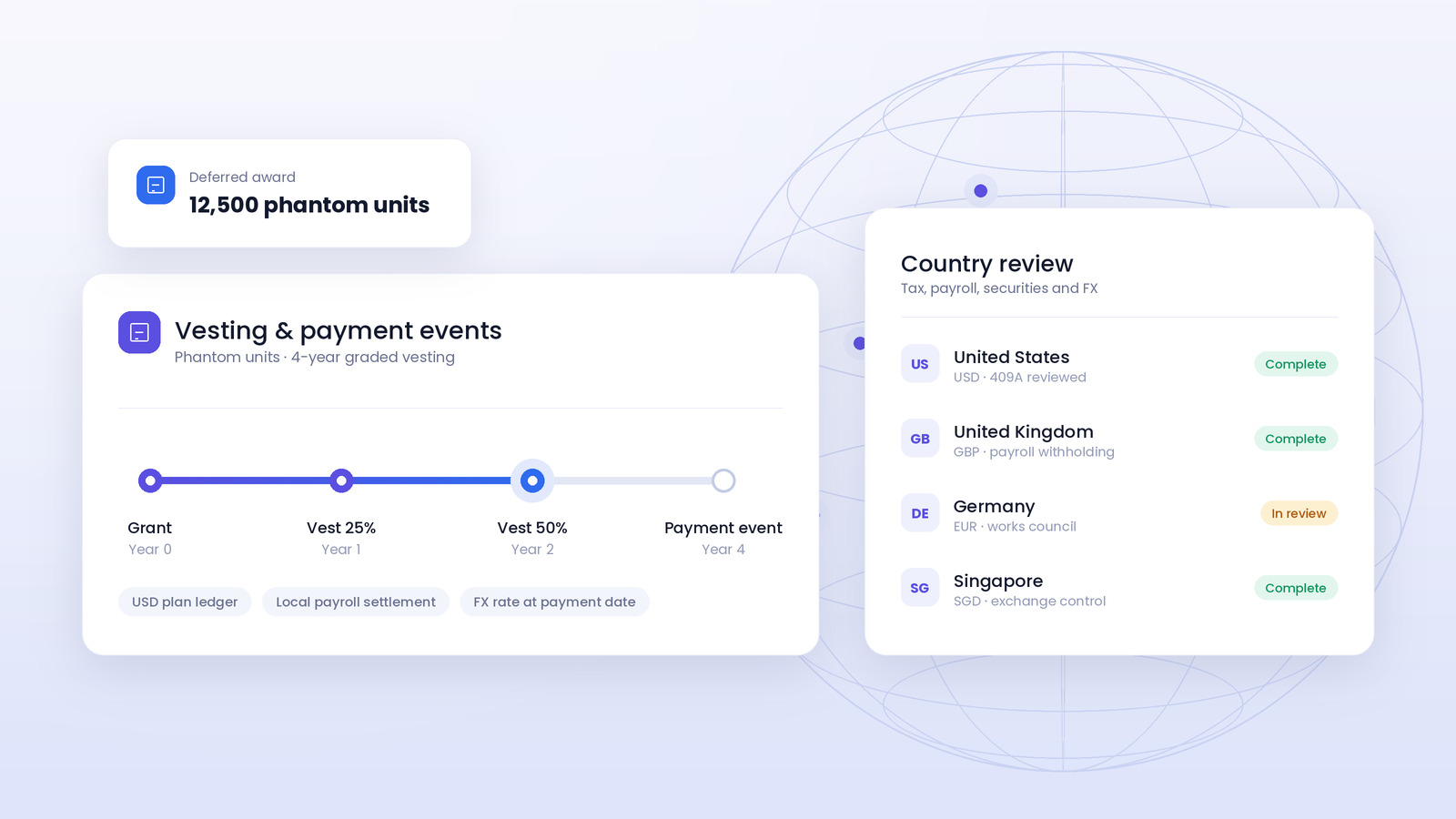

A deferred compensation plan for international employees grants or credits compensation now and pays it later under defined vesting and payment rules. The challenge is making that promise understandable, fundable, and administratively workable across countries with different tax, payroll, employment, securities, currency, and reporting requirements.
For a domestic workforce, one plan document and one payroll process may be sufficient. For a global workforce, the better model is usually a central framework supported by country-specific review and operating rules. This preserves a consistent economic benefit while allowing the mechanics to change where local requirements differ.
This guide outlines the principal decisions employers should make when designing a global deferred compensation or phantom equity program. It is a practical planning framework rather than legal, tax, accounting, or investment advice.
1. Start With the Business Objective
A deferred compensation plan should solve a clearly defined compensation problem. Common goals include retaining executives or specialist employees, aligning rewards with long-term company performance, sharing value with employees who cannot easily join a domestic equity plan, supplementing retirement benefits, or delaying compensation until a future milestone.
The objective determines almost every decision that follows. A retention plan may emphasize time-based vesting and forfeiture on early departure. A performance plan may use revenue, profitability, or individual targets. A phantom equity plan may track enterprise value or share appreciation. A supplemental retirement arrangement may focus on contributions, account balances, and retirement payment dates.
Write the objective in one sentence before drafting the plan. That sentence becomes a useful test for every later design choice.
2. Define Eligibility and the Responsible Employer Entity
Eligibility should be objective enough to administer consistently but flexible enough to support the company's talent strategy. Employers should identify whether participation is limited to executives, a defined leadership group, specified roles, employees above a compensation threshold, or individually selected key employees.
For international plans, the legal employer matters. A participant may work for a foreign subsidiary, employer-of-record provider, branch, or parent company. The entities granting the award, employing the participant, processing payroll, and ultimately paying the benefit may differ. That structure can affect withholding, deductibility, transfer pricing, accounting, employment claims, and corporate approvals.
The plan should establish which company sponsors the program, which countries and worker types are eligible, who approves grants and exceptions, and what happens when a participant transfers between group entities or countries. A relocation can change tax residence, payroll, currency, and legal protections, so mobility should trigger a formal review.
3. Choose the Economic Structure
Deferred compensation describes a family of arrangements rather than a single product. An account-balance arrangement credits a participant with employer contributions, employee deferrals, notional earnings, or a combination. A deferred cash award grants a fixed amount or formula-based bonus that vests and pays later.
A phantom equity plan grants hypothetical units linked to company value or appreciation without issuing actual shares or voting rights. It can provide equity-like economics while avoiding some of the complexity of issuing real equity across many countries. However, employers should not assume that calling an award phantom equity produces capital-gains or equity tax treatment. The classification depends on the documents and local rules.
A performance-based long-term incentive calculates value using company, business-unit, or individual results over multiple years. The plan must define the measurement method precisely enough that participants and administrators can reproduce it.
The company should also decide whether benefits are an unsecured corporate promise or supported by a trust, insurance policy, escrow, or other funding mechanism. Funding can improve benefit security but may change tax, regulatory, accounting, or insolvency outcomes.
4. Define Valuation Rules Clearly
Vague valuation language creates disputes. A phantom equity plan should specify whether units track full share value or only appreciation, which class of shares or enterprise metric is used, how debt and cash are treated, and what happens after stock splits, recapitalizations, acquisitions, dividends, or new share classes.
Private companies need a repeatable valuation process. The plan might use the price from a financing round, an independent valuation, a board-approved formula, or the value paid in a liquidity event. Each method has tradeoffs. Financing-round prices may include investor rights employees do not receive, while formulas are predictable but may diverge from market value.
The plan should identify the valuation date, the decision-maker, and the dispute process. Account-balance plans should similarly define the notional investment return or crediting rate and explain whether the employer actually purchases corresponding assets.
5. Design Vesting and Leaver Rules
Vesting determines when a participant earns a nonforfeitable right. Time-based vesting may be annual, monthly, graded, or cliff-based. Performance vesting may depend on revenue, profit, valuation, product, or individual objectives. Hybrid structures combine service and performance.
International employers should test whether forfeiture provisions are enforceable in each country. Local employment laws may limit forfeiture of compensation considered earned, particularly after termination without cause, redundancy, retirement, disability, or protected leave.
Plan documents should distinguish resignation, termination for cause, termination without cause, redundancy, retirement, disability, death, and transfers within the corporate group. Avoid relying only on labels such as good leaver and bad leaver. Define the events and the treatment of vested and unvested awards.
6. Select Objective Payment Events
Vesting and payment are different. An award can vest in one year and remain payable later. Common payment events include a fixed date, specified anniversary, retirement, separation from service, death, disability, qualifying change in control, or a scheduled period after vesting.
The plan should state whether payment is a lump sum or installments and identify a clear payment window. For arrangements potentially subject to U.S. Internal Revenue Code Section 409A, payment events, deferral elections, later changes, and acceleration restrictions require particular care. International status does not automatically eliminate U.S. considerations for U.S. taxpayers or employees with U.S. service.
Avoid language such as “when the company considers it appropriate” or “after an exit” without a precise definition. Define what counts as a change in control, what happens in an asset sale, and whether a public offering triggers payment.
7. Establish Currency and Foreign-Exchange Rules
A global plan needs a written currency policy. The award may be denominated in U.S. dollars while the participant is paid in euros, pounds, pesos, or another currency. Without written conversion rules, outcomes can depend on processing dates or payroll practices.
Define the accounting currency, payment currency, exchange-rate source, conversion date, and who bears foreign-exchange movements. Address blocked currencies, exchange controls, and countries where payment must pass through local payroll or an approved banking channel.
If an employee relocates, decide whether the award remains in the original currency or converts to the new payroll currency. Participant statements should show the plan currency and an indicative local value while explaining that final payment may differ.
8. Coordinate Country-Level Reviews
A central plan document should be supported by a country matrix. For every participant location, identify the likely tax point, withholding and social contribution obligations, payroll reporting, employer deductibility, securities treatment, exchange-control restrictions, employment risks, data requirements, and participant disclosures.
The tax point may occur at grant, vesting, payment, or another event depending on the structure and jurisdiction. Cash-settled phantom awards are often treated as employment income, but timing and payroll mechanics vary. Actual shares, options, and cash-settled units may be classified differently even when their economics look similar.
Review the participant's facts as well as the plan: nationality, tax residence, work location, mobility history, employer entity, and U.S. taxpayer status can all matter. The country matrix should be refreshed before new-country grants, material amendments, payment events, and employee relocations.
9. Plan for Funding, Cash Flow, and Accounting
Deferred compensation creates a future obligation. Finance teams should forecast vesting, value growth, employee departures, payment dates, payroll taxes, foreign exchange, and transaction scenarios. Phantom equity can create a large liability if company value rises quickly and many awards pay at the same event.
The company should establish who calculates the liability, how often it is remeasured, which accounting standard applies, and how management and the board receive reports. Funding does not always require setting aside the full benefit immediately, but it does require a deliberate policy rather than an assumption that future cash will be available.
10. Build Governance Before the First Grant
Even a well-drafted plan can fail through inconsistent administration. Create a workflow covering plan approval, eligibility, grant documentation, elections, vesting, valuation, employee changes, payments, tax instructions, and record retention.
Assign ownership across HR, finance, payroll, legal, and the board or compensation committee. Maintain one source of truth for each participant's grant, balance or units, vesting history, elections, payment event, currency, and country review.
Participant statements should clearly separate vested value, unvested value, estimated value, and guaranteed amounts. Employees should understand that phantom equity is not actual ownership unless the documents explicitly provide shares. Every grant, amendment, valuation, approval, and payment should have an audit trail.
International Deferred Compensation Design Checklist
- What business outcome is the plan intended to produce?
- Which employees, countries, worker types, and employing entities are covered?
- What is being granted: cash, account credits, full-value phantom units, appreciation units, or performance awards?
- How is value calculated, approved, and communicated?
- What vesting and departure rules apply?
- Which events trigger payment, and what is the payment window?
- Which currency and foreign-exchange rules apply?
- What country-specific tax, payroll, employment, securities, exchange-control, and data rules have been reviewed?
- How will the obligation be accounted for and funded?
- Who owns ongoing administration, reporting, and participant support?
If any answer depends on an unwritten interpretation or a spreadsheet owned by one person, the operating model is not ready.
How Redii Supports Deferred Compensation for Global Teams
Redii helps employers design and administer deferred compensation and phantom equity programs for distributed workforces. Employers can configure eligibility, worker categories, vesting, deferral elections, payout timing, and reporting while maintaining a centralized record for participants across countries.
The goal is not to replace qualified legal or tax advice. It is to turn an approved plan design into a repeatable process: grants are recorded consistently, vesting is tracked, participant information is accessible, and employer reporting is available without rebuilding the program in spreadsheets.
Deferred compensation can be a meaningful tool for retaining and rewarding international employees, but its value depends on disciplined design. Start with the business objective, define the economics precisely, review each country, and build the administration before making promises to employees.
Employer Decision Framework
Design the operating rules before issuing awards.
The useful next step is to convert the article's concepts into a documented employer decision, with clear owners, evidence and review dates.
- Identify the responsible employer entity for each participant.
- Use objective vesting, valuation and payment terms.
- Create a country review and payroll process for every payout.
For implementation, see Redii Deferred Compensation. Redii can help administer the approved design, but employers should obtain legal, tax, investment and insurance advice for the countries and employee populations involved.
Authoritative References
Frequently Asked Questions
Can one deferred compensation plan cover employees in several countries?
A central framework can cover multiple countries, but the legal, tax, payroll, employment, securities, currency, and data treatment should be reviewed for each participant location.
Is phantom equity the same as actual equity?
No. Phantom equity generally creates a contractual right to a future cash payment linked to company value without granting shares, voting rights, or ownership.
When should deferred compensation be paid?
The plan should define objective payment events and payment windows, such as a fixed date, separation from service, retirement, death, disability, or a qualifying change in control.