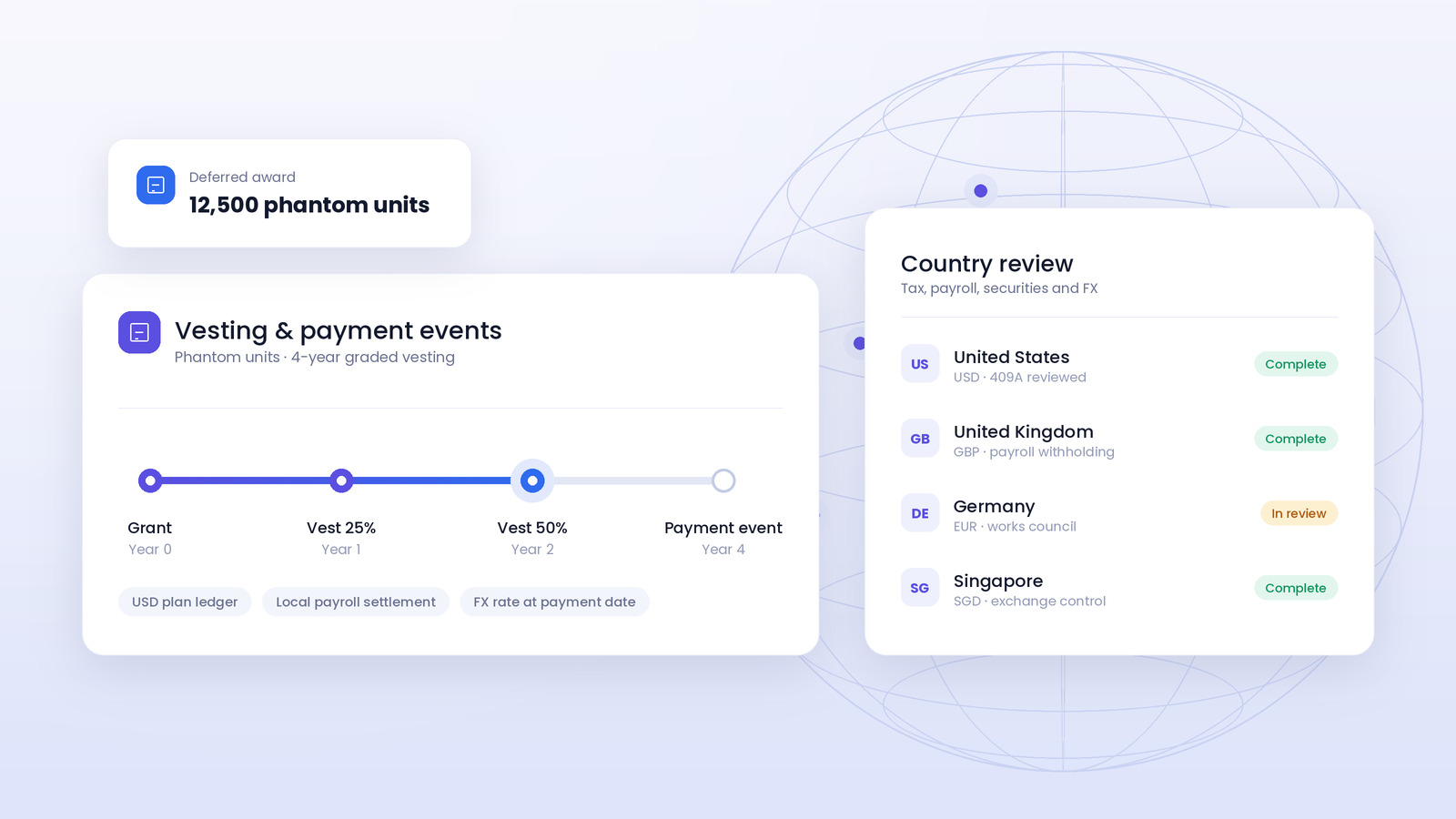



As companies expand across borders, the way they compensate employees is changing. Salary and cash bonuses still matter, but they are no longer enough on their own to attract and retain top global talent. Employees increasingly want to understand how their work connects to long-term value creation. Employers, meanwhile, are looking for ways to reward key contributors, strengthen retention, and create incentives that scale across international teams.
That is where deferred compensation comes in.
Deferred compensation is a broad term for compensation that an employee earns or is granted today but receives at a later date. It can take different forms, from nonqualified deferred compensation plans that allow certain employees to defer income into the future, to phantom equity plans that give employees economic exposure to company growth without issuing actual shares.
For global companies, deferred compensation is becoming more relevant because it sits at the intersection of several important workforce trends. Companies are hiring internationally earlier. Senior talent is increasingly distributed across countries. Startups and growth companies want to offer long-term upside without creating unnecessary equity complexity. Larger employers want flexible tools for rewarding key employees outside their domestic benefits framework.
Deferred compensation is not a replacement for salary, bonuses, equity, or retirement benefits. But when designed thoughtfully, it can become a powerful addition to a global compensation strategy.
What Is Deferred Compensation?
At its simplest, deferred compensation means an employee receives compensation in the future instead of immediately. The employee may earn a bonus, incentive award, or other benefit in one period, while actual payment is scheduled for a later period.
The purpose can vary. In some cases, deferred compensation is used as a retirement or executive benefit. In others, it is used as a retention tool, with payment tied to continued employment through a vesting period. It may also be used to align employees with long-term company performance, particularly when the value of the award depends on company growth or a future liquidity event.
There are many ways to structure deferred compensation. Some plans are elective, meaning an employee chooses to defer a portion of compensation they would otherwise receive currently. Others are non-elective, meaning the employer grants a deferred award as part of a compensation or retention package.
The common thread is timing. The value is earned or granted now, but payment occurs later under the terms of the plan.
That delayed payment can create a meaningful incentive. If an employee knows that a portion of their compensation vests over several years or pays out upon a future event, they may have a stronger reason to stay and contribute to the company’s success.
Why Deferred Compensation Is Getting More Attention
Deferred compensation has existed for a long time, particularly in executive compensation. What is changing is the audience and the use case.
Historically, many long-term incentive programs were built around domestic executives at large companies. Global employees were often left out, either because the company lacked the infrastructure to support them or because cross-border administration felt too complicated. But that model is increasingly out of step with how modern companies operate.
A company headquartered in the United States may now have key employees in the United Kingdom, Canada, Brazil, India, Singapore, Germany, and dozens of other markets. Some of those employees may be senior leaders. Others may be early team members who are critical to product, sales, customer success, or operations. If the company wants those employees to think and act like long-term stakeholders, it needs compensation tools that extend beyond one country.
Deferred compensation is gaining attention because it can help companies answer a difficult question: how do we create long-term incentives for international employees in a way that is flexible, understandable, and administratively manageable?
For some companies, the answer may be a nonqualified deferred compensation plan. For others, it may be a phantom equity plan. In many cases, the right structure depends on the company’s goals, workforce, stage, and legal and tax considerations.
Nonqualified Deferred Compensation Plans
A nonqualified deferred compensation plan, often shortened to NQDC, is a plan or arrangement that provides for compensation to be paid in a future year. Unlike a qualified retirement plan, such as a U.S. 401(k), a nonqualified plan does not need to satisfy the same broad-based qualification rules. That can give employers more flexibility in who participates and how benefits are structured.
This flexibility is one reason NQDC plans are commonly associated with executives, senior employees, and other key talent. A company may use an NQDC plan to provide supplemental retirement benefits, deferred bonuses, or additional long-term incentives beyond what is available through standard retirement or benefit programs.
For global companies, the appeal is straightforward. Many employers want to offer enhanced benefits to important employees, but qualified domestic plans often do not translate cleanly across borders. A U.S. 401(k), for example, is designed for U.S. employees. International employees may not be eligible, may not receive the same tax benefits, or may need a different structure entirely.
A nonqualified deferred compensation arrangement can give employers more room to design a tailored benefit for selected employees. The plan might define eligibility, contributions or awards, vesting schedules, payout timing, and conditions for payment.
That flexibility can be valuable, but it also requires discipline. Deferred compensation plans need to be structured carefully. In the United States, Section 409A is a key framework for nonqualified deferred compensation, including rules around deferral elections, permissible payment events, and the timing and form of payments. For international employees, local tax, labor, securities, and employment rules may also matter. Companies should work with qualified advisors when designing and implementing these programs.
The point is not that deferred compensation is too complex to pursue. Rather, it is that the plan should be intentional. A well-designed plan can support retention and long-term alignment. A loosely designed plan can create confusion for both the employer and employee.
Phantom Equity Plans
Phantom equity is another form of deferred compensation that is especially relevant for startups, private companies, and global employers.
A phantom equity plan gives employees a contractual right to receive value based on the company’s equity value or growth, without giving them actual ownership in the company. Instead of issuing real shares or options, the company creates a cash-settled or value-linked award that mirrors some of the economics of equity.
For example, an employee might receive phantom units that track the value of company shares. If the company’s value increases over time, the phantom award may increase in value as well. Depending on the plan design, the employee might receive payment upon vesting, a sale of the company, an IPO, or another defined payout event.
There are different types of phantom equity. A full-value phantom award may track the full value of a hypothetical share or unit. An appreciation-only award may only reward the increase in value from the grant date onward, similar in economic concept to a stock appreciation right.
Phantom equity can be attractive because it gives employees a sense of ownership economics without necessarily creating actual shareholder rights. Employees may participate in the company’s upside, while the company avoids some of the complexity of issuing real equity across multiple jurisdictions.
That can be particularly useful for international teams. Granting actual stock options or shares to employees in many countries can raise local securities, tax, payroll, exchange control, and administrative considerations. Phantom equity does not eliminate all complexity, but it may provide a more flexible path for companies that want to share long-term value with employees globally.
Phantom equity can also help private companies manage dilution. Because employees are not receiving actual shares, the company can provide equity-like economics without expanding the shareholder base in the same way. For founders and finance teams, that can be an important consideration.
At the same time, phantom equity requires thoughtful design. Companies need to define how value is measured, when awards vest, when payouts occur, what happens if an employee leaves, and how the company will fund future obligations. A phantom equity plan can be powerful, but employees need to understand it clearly for it to serve as a motivational tool.
How Deferred Compensation Helps Attract Talent
Top candidates increasingly compare opportunities across borders. A strong salary may get their attention, but long-term incentives can help a company stand out.
Deferred compensation can make an offer more compelling by showing that the company is willing to invest in the employee’s future. For senior hires, it can help bridge gaps between local market compensation and the broader value of the role. For early employees, it can create a sense of participation in long-term company growth. For employees in countries where traditional equity grants are difficult to administer, deferred compensation may provide an alternative way to offer upside.
This matters because global hiring is competitive. Companies are not only competing with local employers. They are competing with remote-first companies, multinational firms, startups, and well-funded scaleups that can hire from the same talent pools.
A deferred compensation program can help communicate a stronger value proposition. It tells candidates that the company is not only focused on immediate productivity. It is also thinking about long-term alignment, retention, and wealth creation.
That message can be especially important for global employees who may otherwise feel excluded from the benefits and incentives available to employees at headquarters.
How Deferred Compensation Supports Retention
Retention is one of the most common reasons companies consider deferred compensation. When structured with vesting schedules or future payout dates, deferred compensation can encourage employees to stay through important business milestones.
For example, a company might grant a deferred bonus that vests over three years. It might provide phantom equity that pays out only if the employee remains employed through a liquidity event. It might create a long-term incentive plan for key leaders that rewards performance over multiple years.
These structures help align employee incentives with company goals. Employees benefit when they stay, contribute, and help the company grow. Employers benefit by creating stronger continuity among important team members.
This can be particularly valuable for global companies because replacing key international talent can be costly and disruptive. Hiring across borders often involves longer recruiting timelines, specialized knowledge, local market dynamics, and operational dependencies. Losing a key country manager, engineering lead, sales leader, or product specialist can slow expansion.
Deferred compensation does not solve retention on its own. Employees still need good managers, meaningful work, fair compensation, career growth, and a healthy culture. But it can add an important long-term incentive layer to the overall employee experience.
When Deferred Compensation Makes Sense
Deferred compensation is not right for every company or every employee. It works best when there is a clear business objective and a clear employee value proposition.
It may make sense when a company wants to retain senior leaders, reward key international employees, create long-term incentives without issuing actual equity, provide supplemental benefits beyond standard retirement plans, or align compensation with future company value.
It may be less appropriate when the company cannot explain the benefit clearly, does not have the administrative capacity to manage the plan, or has not considered how payouts will be funded. Deferred compensation should not be treated as a vague promise. Employees need clarity around what they are receiving, when they may receive it, and what conditions apply.
Communication is essential. A deferred compensation plan can be valuable on paper but ineffective if employees do not understand it. This is especially true for phantom equity, where employees may be unfamiliar with how hypothetical units, valuation, vesting, and payout events work.
A strong plan should answer practical questions: What am I eligible to receive? How is the value determined? When does it vest? When is it paid? What happens if I leave? What happens if the company is sold? What tax treatment might apply in my country?
Companies do not need to overwhelm employees with technical details in every communication. But they should provide enough transparency for employees to appreciate the value and make informed decisions.
Deferred Compensation and Global Benefits Strategy
Deferred compensation should be viewed as part of a broader global benefits strategy, not as a standalone fix.
Global employees need a well-rounded benefits experience. That may include health benefits, retirement savings, paid time off, recognition, flexible rewards, and long-term incentives. Deferred compensation can fit into this picture by adding a layer of future-oriented value, particularly for key employees.
This is where many companies are starting to rethink their approach. Rather than simply replicating a domestic benefits package internationally, they are asking what global employees actually need and what can be delivered consistently across markets.
For some employees, an international retirement plan may be the most important long-term benefit. For others, a deferred compensation or phantom equity plan may provide additional upside tied to company growth. For day-to-day culture, flexible rewards and recognition may help employees feel appreciated in the moment.
The best global benefits strategies combine these elements thoughtfully. They support both immediate engagement and long-term financial wellbeing. They help employees feel included, whether they are based at headquarters or halfway around the world.
Redii and Deferred Compensation for Global Teams
As global hiring becomes more common, companies need better tools for delivering benefits and long-term incentives across borders. That is the problem Redii is built to help solve.
Redii helps companies support their international employees through a modern global benefits platform. As part of that broader mission, Redii’s Deferred Compensation solution is designed to help employers create long-term incentive programs for global teams, including structures such as nonqualified deferred compensation plans and phantom equity plans.
For employers, this can make it easier to design and administer programs that support retention, align employees with long-term company goals, and provide meaningful benefits beyond salary. For employees, it can create a clearer path to participating in future value, whether through deferred awards, phantom equity, or other long-term incentive structures.
Deferred compensation is especially relevant for companies that want to compete globally for talent but do not want international employees to feel like an afterthought. A well-designed plan can help employees see that they are part of the company’s long-term future.
Redii also supports companies with international retirement benefits, helping employers offer long-term financial wellbeing solutions to employees outside their home country. Together, deferred compensation and global retirement benefits can help companies build a more complete benefits experience for international teams.
The future of work is global. Compensation and benefits need to catch up. Deferred compensation gives companies another tool to attract, retain, and reward the people who will help them grow across borders. With the right structure, clear communication, and a platform built for global teams, employers can turn long-term incentives into a competitive advantage.
Employer Decision Framework
Use deferred compensation for a defined talent and reward objective.
The useful next step is to convert the article's concepts into a documented employer decision, with clear owners, evidence and review dates.
- Choose the eligible population and economic promise.
- Separate vesting conditions from payment timing.
- Model cross-border tax, payroll and employer cash exposure.
For implementation, see Redii Deferred Compensation. Redii can help administer the approved design, but employers should obtain legal, tax, investment and insurance advice for the countries and employee populations involved.