

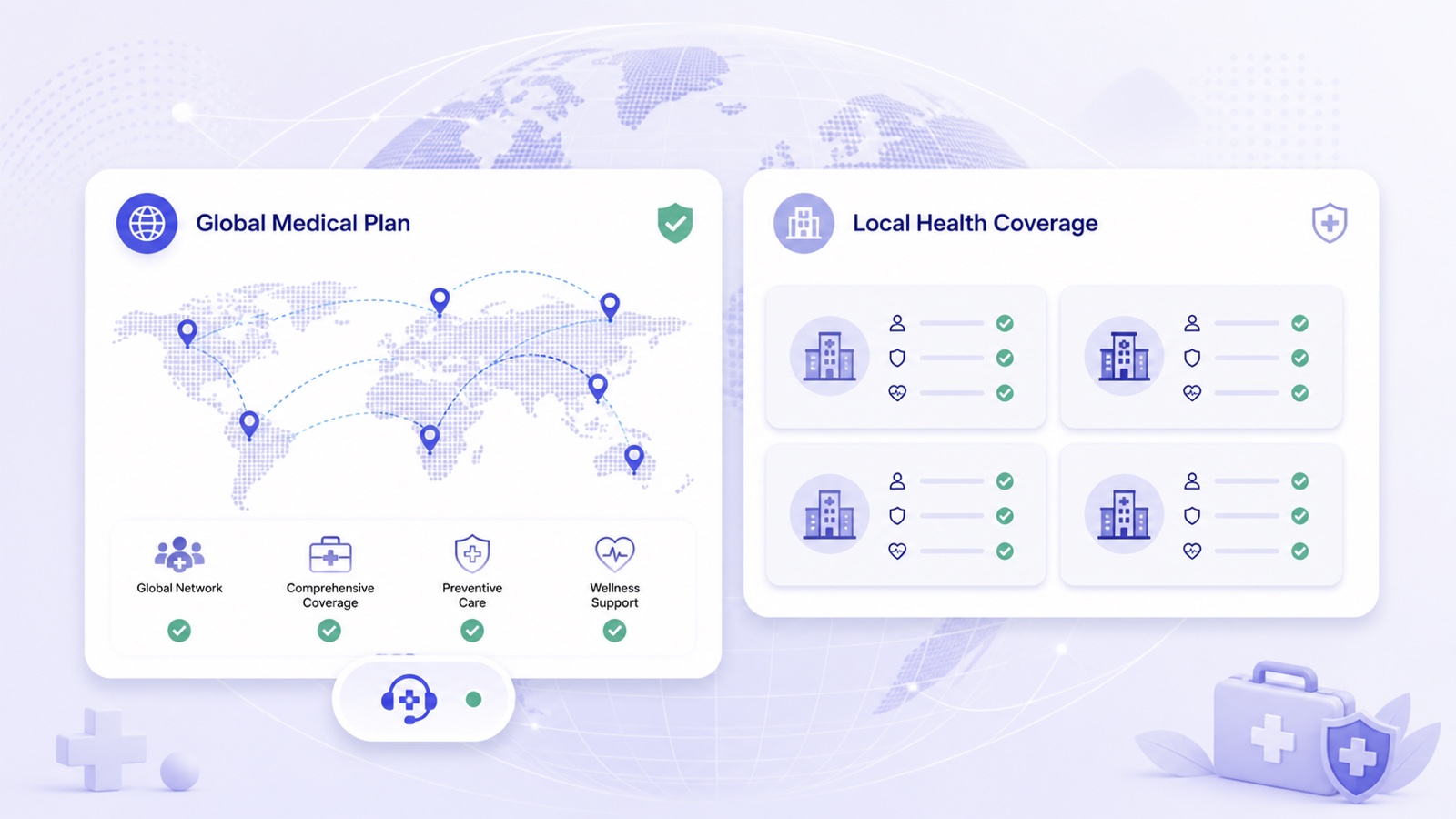

International health insurance for employees should match where people live, how often they move, and which healthcare systems they can actually use. A global medical plan can provide consistent cross-border protection, while local coverage may deliver stronger domestic networks and closer alignment with national rules. Travel insurance and expatriate policies fill different gaps and should not be treated as interchangeable.
The right answer is often a portfolio rather than one policy for everyone. Employers need a decision framework that separates statutory obligations from voluntary coverage, permanent residents from short-term travelers, and broad policy language from the real employee experience at the point of care.
This guide compares the main coverage models and shows how global employers can choose and administer them. It is a planning framework, not insurance, legal, tax, or medical advice.
Start With the Employee Population, Not the Product
Before requesting quotes, map the people the program must support. Record each employee's country of residence, employing entity, nationality where relevant to eligibility, expected travel, dependants, remote-work pattern, and likely duration in the location. A locally hired employee who rarely travels has different needs from an executive on a three-year assignment or a project worker moving every quarter.
Segment the population into practical groups: stable local employees, globally mobile employees, expatriates and assignees, frequent business travelers, cross-border commuters, and dependants. Then identify which benefits are mandatory and which are intended to create a competitive employee experience.
This prevents a common mistake: purchasing a global-looking policy and discovering later that employees cannot access routine care, the provider network is thin, or the plan does not satisfy local enrollment or contribution requirements.
What Is a Global Medical Plan?
A global medical plan is designed to cover eligible employees across multiple countries under one policy framework. It may offer worldwide or regional provider networks, direct settlement with hospitals, multilingual assistance, emergency evacuation, and common benefit limits. Employers often use these plans for mobile employees, senior hires, expatriates, or groups in countries where comparable local benefits are difficult to arrange.
The administrative advantage is consistency. A central team can negotiate common coverage categories, renewal terms, reporting, and service standards. Employees who relocate may be able to remain under the same overall arrangement, subject to underwriting, sanctions, licensing, and country eligibility.
Consistency does not mean identical outcomes. Provider availability, direct billing, taxes, compulsory insurance, and permissible policy structures vary by country. A global plan should be tested against each location rather than assumed to override the local system.
What Is Local Health Coverage?
Local coverage is issued for a specific country and usually aligns closely with its healthcare market. It may be a compulsory social health arrangement, an employer-sponsored group policy, a private supplemental plan, or a combination. Local insurers often have deeper domestic provider contracts, familiar claims processes, and documentation that employees and payroll teams recognize.
Local plans can be cost-effective for employees who live and receive most care in one country. They may also integrate better with public coverage, statutory contributions, tax rules, and local benefit expectations. The tradeoff is fragmentation: the employer may manage different brokers, renewal calendars, currencies, eligibility rules, and data files across every market.
Relocation can also interrupt coverage. The employee may leave one plan, satisfy new enrollment conditions, and begin another while managing ongoing treatment or dependants. A central benefits register and a documented transfer process are essential.
Global Plans vs. Local Coverage
Provider access: local plans often have the strongest domestic network; global plans may offer broader international access and assistance. Confirm actual hospitals and clinics, not only network size.
Mobility: global plans may follow an employee between eligible countries more easily. Local policies are usually tied to residence or employment in one market.
Compliance: local plans may fit national insurance and tax rules more naturally. A global plan may still require local wrappers, compulsory contributions, or supplemental coverage.
Administration: a global arrangement can simplify governance and reporting. Local plans multiply vendors and processes but may reduce country-level exceptions.
Cost: local coverage can be less expensive in many markets, while a global plan prices for portability, international networks, and higher service levels. Compare total cost, including broker fees, taxes, employer contributions, employee out-of-pocket exposure, and internal administration.
Employee experience: the best plan is the one employees can understand and use. Test language support, mobile claims, direct billing, preauthorization, response times, and escalation paths.
Travel Insurance Is Not Employee Health Coverage
Travel insurance is generally designed for temporary trips and unexpected events. It may cover emergency treatment, medical evacuation, cancellation, baggage, or disruption, depending on the policy. It usually is not designed to provide routine primary care, chronic-condition management, maternity coverage, or long-term resident care.
The distinction is recognized by public authorities. The European Commission explains that the European Health Insurance Card provides access to medically necessary state care during temporary stays, but is not an alternative to travel insurance and does not cover private care or repatriation. The U.S. Department of State likewise advises travelers to check whether their regular insurance covers care abroad and distinguishes travel medical coverage from medical evacuation insurance.
For employers, the practical rule is simple: use travel coverage for temporary travel risks, not as the default health plan for someone who is living and working in another country.
When Expatriate Health Insurance Fits
Expatriate policies are a form of international medical coverage tailored to employees and families living outside their home country. They commonly include private inpatient and outpatient care, cross-border treatment options, evacuation, and assistance services. Some provide home-country coverage or continuation during travel.
They are most useful when an employee is on a defined assignment, moves frequently, needs continuity across borders, or lives where local private coverage is limited. They may be excessive for a permanently local workforce with strong domestic systems and little travel.
Review the definition of home country, country of residence, area of cover, planned treatment, emergency evacuation, maternity waiting periods, pre-existing conditions, mental health, prescription drugs, dental and vision benefits, and dependant eligibility. Policy names are less important than the written terms.
A Practical Decision Framework
- Confirm statutory requirements. Identify compulsory public enrollment, employer contributions, minimum private insurance, visa conditions, and required local documents.
- Map utilization. Determine where employees will obtain routine, specialist, emergency, and planned care.
- Set a global minimum. Define the coverage categories and service standards the company wants every eligible employee to receive.
- Choose the delivery model. Use local plans, a global plan, an expatriate plan, or a coordinated combination.
- Test employee costs. Model deductibles, copayments, coinsurance, exclusions, and upfront payment requirements.
- Plan mobility. Establish what happens when an employee relocates, travels, takes leave, adds a dependant, or ends employment.
- Document exceptions. Record why a country or employee group uses a different arrangement and who approved it.
Questions to Ask Insurers and Brokers
- Which countries and employee types are eligible?
- Which providers offer direct billing in each employee location?
- How are pre-existing and chronic conditions treated?
- Are mental health, maternity, preventive care, prescriptions, and rehabilitation covered?
- What preauthorization and medical-necessity rules apply?
- When is evacuation approved, and who chooses the destination?
- Which currencies are used for premiums, limits, and reimbursement?
- How are claims, complaints, and urgent escalations handled?
- What employee and dependant data is collected, stored, and transferred?
- How do renewals, rate changes, and termination affect ongoing treatment?
Build One Operating Model Across Multiple Plans
Even when coverage is local, administration can be centralized. Maintain a benefits register containing the insurer, broker, policy number, eligible population, renewal date, contribution method, currency, key exclusions, and escalation contacts for every country. Connect eligibility changes to HR and payroll workflows so new hires, relocations, leaves, dependants, and terminations are processed consistently.
Give employees a plain-language summary showing where to obtain care, how to present coverage, when preauthorization is needed, what they may need to pay upfront, and whom to contact in an emergency. A technically comprehensive plan still fails if employees do not know how to use it.
How Redii Supports Global Benefits Administration
Redii helps employers maintain a centralized view of benefits for distributed teams, including eligibility, providers, renewal dates, member records, and reporting. A common administration layer makes it easier to coordinate local and global health arrangements without pretending every country works the same way.
The objective is controlled flexibility: a consistent employer standard, supported by country-appropriate coverage and a repeatable process for enrollment, mobility, and employee support. Learn more about Redii's global employee benefits platform.
Employer Decision Framework
Match coverage to the employee population and mobility pattern.
The useful next step is to convert the article's concepts into a documented employer decision, with clear owners, evidence and review dates.
- Separate routine care, emergencies and medical evacuation.
- Compare provider access in employee locations, not just headline network size.
- Define how local and global policies coordinate when both apply.
For implementation, see Redii International Health Insurance. Redii can help administer the approved design, but employers should obtain legal, tax, investment and insurance advice for the countries and employee populations involved.
Authoritative References
Frequently Asked Questions
Is international health insurance the same as travel insurance?
No. Travel insurance is generally designed for temporary trips and emergencies, while employee medical coverage must support the worker's expected residence, routine care, ongoing treatment, and local compliance needs.
Should every international employee receive the same health plan?
Not necessarily. Employers can use a consistent global standard while selecting local, regional, or international coverage according to residence, mobility, provider access, cost, and legal requirements.
What should employers compare besides the premium?
Compare provider access, direct billing, exclusions, pre-existing condition rules, maternity and mental health coverage, evacuation, claims service, currencies, renewals, data handling, and employee communications.